WORTH KNOWING · CARE & LATER LIVING
Care and later living need more land, but a national shortfall says little about whether any particular site is right for them. Telling a credible opportunity from wishful thinking means testing local demand, operator economics, planning and the land itself, and being prepared to accept the answer.
New care homes have continued to open across the UK this decade, yet the country has barely added to its stock of beds. Savills’ June 2026 care home development report found that the sector delivered around 30,000 new beds between 2020 and 2025 but decommissioned around 29,000. The same research projects a requirement for around 139,000 additional beds by 2036, roughly 30% of current supply. That projection assumes today’s age-specific dependency rates and occupancy levels.
Read together, those figures describe a sector largely replacing what it lost while the requirement ahead keeps growing. For a landowner with a field on the edge of a settlement or a redundant commercial site, they can appear to point towards an obvious development opportunity.
That reading needs testing. A national shortfall makes the case for more provision, not for any particular site. Local supply, competing proposals, the type of care required and the economics of the catchment can each undermine an opportunity that looks compelling from a distance.
When we assess land for care or later living, the first question is whether it deserves promotion for those uses at all, and only then how to bring a scheme forward.
What makes land suitable for care home development?
Meeting the site requirements for care home development takes more than acreage. It must serve an evidenced local market and support an operator’s commercial and staffing model. It also needs a credible route to planning permission and room for a workable building, with access, servicing and outdoor space. We consider those tests together, and sometimes the right conclusion is that a different use would serve the site better.
National need does not guarantee local demand
An ageing population is where any assessment of need starts, but it rarely settles the question. Government planning guidance for England describes the need to provide housing for older people as critical. When we appraise a site, we look more closely at projected growth in the 75-plus and 85-plus age groups than at the over-65 population as a whole.
Existing and planned supply can change the picture
Supply is the other half of the calculation. It covers the registered beds or later living units already serving the catchment, how modern they are, what has closed or opened recently and what already has consent or awaits a decision. This is where an apparent opportunity can weaken quickly. An area with a large older population may already have plenty of modern homes, or competing schemes moving through the planning system. Equally, an area that has lost several older homes may have a stronger case than its headline provision suggests. Savills and government data for England measure occupancy differently, but both put it in the mid-to-high 80s. A national shortfall therefore still needs testing against the quality, age, utilisation and pipeline of local supply.
Care homes and later living are different products
The type of need matters as much as its scale. Residential, nursing and dementia care serve different residents and call for different buildings and staffing. Extra care and retirement living provide homes for people living independently with varying levels of support. They usually involve other operators and customers, and may fall within a different use class. A demand figure for one says little about demand for another.
An operator has to be able to make the location work
A local shortfall shows a need for accommodation, but operators commit only where they are confident a scheme will stay full and properly staffed for years to come.
The geography of recent delivery makes the point. The same Savills research found that southern England accounted for more than a third of care home completions between 2020 and 2025 and around 40% of the current pipeline. Savills links that concentration to stronger viability in affluent, private-pay markets. It also notes that many lower-fee markets, often already underserved, still struggle to attract new supply. Set against the national shortfall, that pattern suggests development has followed viability at least as closely as it has followed need.
What care home operators look for in a site
An operator will test whether the catchment is large enough and whether fees or sales values can support a modern building. It will also weigh the competing supply in the pipeline and whether the location fits its model. Published thresholds vary widely, and none of them is an industry rule. For Müller, a starting point for care home and later living land promotion is a catchment of at least 30,000 people within three miles. ExtraCare, which develops retirement villages, looks for 100,000 people or more within five miles. Both are screening indicators shaped by a particular product, and a site that clears one still needs testing against the operators who might take it on.
Staffing is part of the location test
Staffing is easy to overlook from outside the sector. Skills for Care estimates that adult social care in England had around 111,000 vacant posts in 2024/25. That is a vacancy rate of about 7%, roughly three times that of the wider economy. Operators therefore need confidence that staff can reach the site for early, late and overnight shifts, and that the local labour market can sustain the home over time.
Location is an operational test as much as a planning one
In England, policy HO9 of the 2026 National Planning Policy Framework expects specialist housing for older or disabled people to sit where residents can reach frequently used services easily and safely. Walking, wheeling, public transport and on-site transport all count, including facilities provided as part of the scheme.
For a care home, residents’ access to appropriate services must sit alongside practical arrangements for staff journeys, family visits, deliveries and emergency access. A site that works on a plan but creates difficult staff shift changes, awkward visitor parking or unreliable ambulance access will not work as well in practice.
Later living puts more weight on walkability
Later living development places greater weight on walkability because residents remain independently active, and straightforward access to shops, healthcare and public transport is part of the proposition. Design guidance for extra care favours relatively flat surroundings within existing residential communities. McCarthy Stone publishes a preference for sites, typically brownfield, within half a mile or an easy walk of shops and amenities, with level access.
Residents need a safe, credible way to reach everyday services and remain part of the surrounding community. That is a more demanding principle than a rule such as “near a GP surgery”.
Supportive policy still needs a site-specific planning case
National policy in England has become more supportive of housing for older people. Policy HO1 of the 2026 NPPF expects plans to take account of the housing needs of older people, including those who require retirement housing, housing-with-care and care homes. Policy HO5 asks plans to identify sites for specialist housing for older people where there is an identified need. Wales has a separate policy framework, so a Welsh site needs its own jurisdiction-specific assessment.
That support does not make planning permission for care home development automatic. Decisions still begin with the development plan, so a site’s prospects depend on the settlement strategy, settlement boundaries, any allocation for another use and the authority’s own evidence of older people’s housing need. Planning history on or near the site can be particularly revealing, showing how the authority has approached access, settlement boundaries, design and specialist accommodation in practice.
C2 or C3: why use class matters early
Planning guidance leaves it to the local planning authority to decide whether specialist older people’s housing falls within Class C2 (residential institutions) or Class C3 (dwellinghouses). It points to factors such as the level of care and the scale of communal facilities. That classification can affect how policies on housing supply, affordable housing and developer contributions apply, and therefore the overall viability of the scheme.
Why need alone will not secure planning permission
Every application must then satisfy the detailed tests of highways and access, design, neighbouring amenity and environmental effects. A strong need case carries weight, but it is unlikely to rescue an access arrangement that does not work or harm that mitigation cannot overcome. Where a site does justify promotion, we build a site-specific planning strategy from the outset. We then manage the planning, design and technical work through to a decision, so the landowner does not have to.
Usable land counts for more than headline acreage
Site size: how much land does a care home need?
Acreage is often the first figure a landowner checks against published care home development site requirements, but gross site area is one of the least reliable measures of a site’s development potential. There is no single answer to how much land a care home needs, because requirements follow the product. Our own screening range for care and later living is one to five acres. Within that, our published guidance suggests a scheme of 60 beds or more usually needs at least one acre, often 1.25 to 1.5 acres after allowing for access, parking and outdoor space. McCarthy Stone seeks 0.75 to 1.5 acres for centrally located retirement schemes, while ExtraCare looks for at least six acres of developable land for a retirement village. These are market examples rather than planning standards, and the operator’s brief will set the real requirement.
Constraints that shrink the developable area
What matters is the net developable area left once constraints have taken their share. Trees, habitats and ecological buffers, drainage, easements, flood risk and access roads can all reduce it, and an awkward boundary can make what remains hard to use. Topography deserves close attention, because on a sloping site the ramps, retaining structures and accessible routes needed for step-free movement can consume a surprising amount of land.
Access, servicing and secure gardens on a care home site
A care home is also a busy workplace. It needs safe access for ambulances and fire appliances, workable drop-off space, staff and visitor parking, and servicing and refuse arrangements kept apart from residents’ areas where required. It also needs secure gardens that residents can genuinely use, rather than whatever landscape space the building and parking leave behind.
Utilities, ground conditions and biodiversity net gain
Utilities and grid capacity, ground conditions, contamination, noise and neighbouring uses all need checking. In England, non-exempt development generally has to deliver at least a 10% biodiversity net gain. In catchments affected by nutrient neutrality, care homes can also fall within the controls because they provide overnight accommodation and add to wastewater. Each can add cost or reduce capacity, and each is site-specific.
One strong indicator is not proof, and the answer may be another use
A site might have a credible planning case and still fail to attract an operator at a land value that works. Equally, an operator’s interest does not resolve a planning objection, an unworkable access or a drainage constraint. An asking price based on a higher-value alternative use can make an otherwise suitable scheme undeliverable, however good its planning prospects.
Constraints do not automatically rule a site out either. A difficult site can still have potential where design or mitigation can overcome its issues and the local need case is particularly strong. Brownfield, edge-of-settlement and surplus institutional land can all work in the right circumstances. Conversely, a level, unconstrained field with good access may still struggle if the catchment is too small or no operator sees a fit.
Reaching the right answer for the site
The most useful conclusion is the right one, which is not always the most optimistic. A site may suit a different form of care from the one first assumed, later living instead of a care home, conventional housing or another use altogether. We weigh those options side by side, because a weak opportunity identified early costs a landowner far less than one pursued too far. A strong one can go all the way to an operating home. Lindley Park in Huddersfield, one of our care home projects, provides an example of that progression. We took the site from an option agreement in early 2022 to planning permission by the end of 2023, and it has since opened under Tanglewood Care Homes.
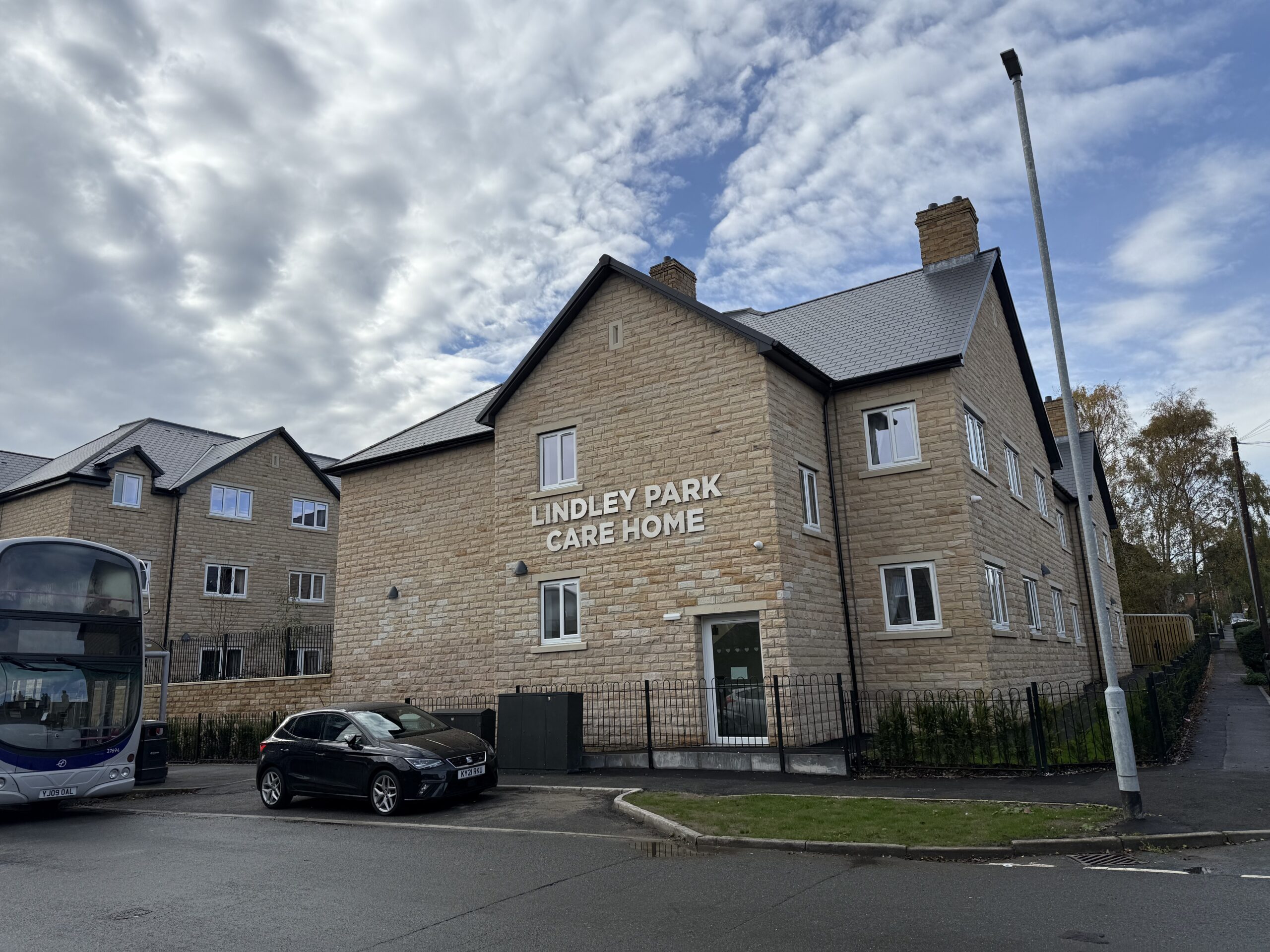
Lindley Park care home, Huddersfield, now run by Tanglewood Care Homes.
What an early appraisal can and cannot establish
Several of the site requirements for care home development are clear from the outset, because demographic data, development plan policy, existing and consented supply, operators’ published criteria and known site constraints are all on record. What that evidence means for a particular site is a matter of professional judgement, and an appraisal should present it as such. Other questions may need survey work, operator discussions and pre-application engagement to answer. They include ground conditions, utility capacity, an operator’s appetite for the location and the planning authority’s response. A useful appraisal says which of these remain open before a landowner commits further time or money.
The national case for more care and later living accommodation is well established. Finding out whether a particular site meets the requirements for care home development, or would suit another use, is where a confidential site appraisal begins.
Find out whether your site could work
If you own an edge-of-settlement, brownfield or surplus institutional site, a confidential appraisal can identify what supports a care or later living scheme, what could prevent delivery and what needs further investigation. If another use looks more appropriate, we will say so. Land agents can refer clients’ sites to us in the same way.